
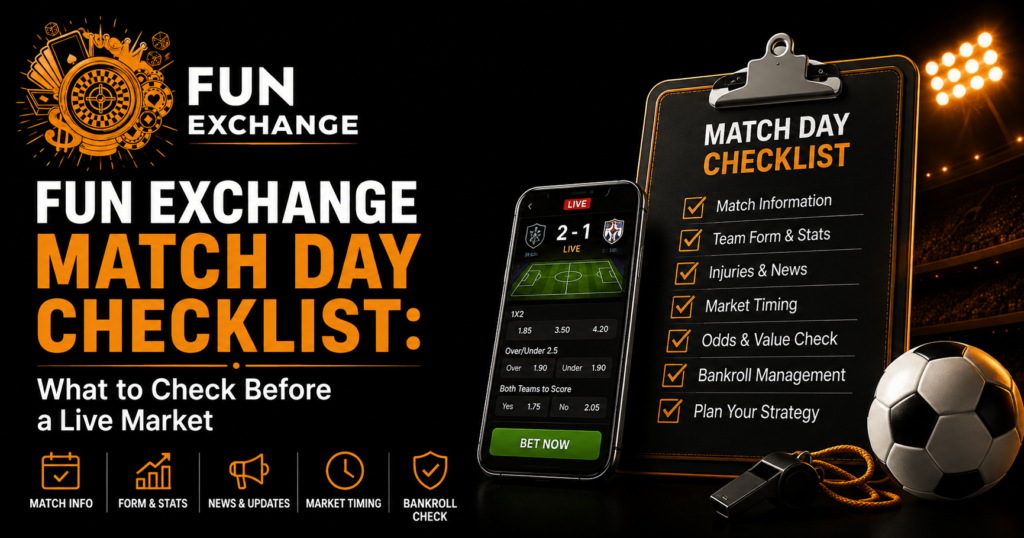
Fun Exchange Match Day Checklist and following its market at the same time can be very different from simply checking the final score.
A team may look strong before the start, but one injury, lineup change, wicket, goal or red card can quickly alter the situation. That is why having a simple checklist can be more useful than reacting to every price movement.
For users following Fun Exchange match-day checklist provides a practical way to organise the information available before and during a sporting event.
The idea is simple: check the event, check the conditions, understand the market, and only then decide whether you want to participate.
This guide explains what to look at before a pre-match or live market without relying on complicated formulas or unnecessary jargon.
What Is a Match-Day Checklist?
A match-day checklist is a short series of checks you complete before making a decision around a sporting market.
It can include:
- Confirming the correct fixture
- Checking team news
- Reviewing the competition and venue
- Looking at recent information
- Understanding the market
- Checking the current price
- Considering available market depth
- Watching for important live events
- Reviewing your own spending limit
The checklist is not designed to predict the result.
Instead, it helps prevent avoidable mistakes caused by rushing into a market without understanding what has changed.
Why a Checklist Matters on Match Day
Sports markets can move quickly.
A cricket lineup announcement can change expectations before the first ball. In football, an unexpected absence can affect the market before kickoff. During a live tennis match, a break of serve can change the situation within minutes.
Funexchange currently promotes live markets across sports including cricket, football and tennis, so the information available to a user can change considerably depending on the event.
A checklist gives you a consistent process.
Instead of asking:
“Why did the price change?”
you can first ask:
“What information changed?”
That small difference can help you make more informed decisions.
The Fun Exchange Match-Day Checklist
1. Confirm the Exact Fixture
Start with the basics.
Before looking at any price, make sure you have opened the correct match.
Check:
- Teams or players
- Competition
- Match date
- Start time
- Venue
- Match format
This is particularly important when several matches are being played on the same day.
For example, cricket schedules can contain multiple matches across different competitions, while football platforms can list domestic league, cup and international fixtures simultaneously.
Never assume that the first result you see is the event you intended to follow.
2. Check the Latest Team News
Team news can be more important than historical statistics.
Look for confirmed information about:
- Starting XI
- Injuries
- Suspensions
- Player availability
- Goalkeeper changes
- Captain changes
- Opening batters
- Bowling combinations
- Player workload
For football, the official lineup can provide important information shortly before kickoff.
For cricket, the playing XI and toss can change the context of a match significantly.
For tennis, physical condition and withdrawal information can become particularly important.
The key is to distinguish confirmed information from speculation.
Do not treat an unverified social media post as equivalent to an official team announcement.
3. Check the Competition and Match Format
The same teams can behave differently depending on the competition and format.
A T20 cricket match is not the same as a Test match.
A domestic football fixture is not necessarily comparable with a Champions League knockout match.
A best-of-three tennis match also creates a different situation from a longer format.
Before making any decision, ask:
What exactly am I watching?
Understanding the format helps put the available market information into context.
4. Consider the Venue
Venue information can provide useful background.
For cricket, consider factors such as:
- Pitch characteristics
- Ground dimensions
- Recent scoring patterns
- Dew conditions
- Toss relevance
For football:
- Home advantage
- Surface
- Weather
- Travel conditions
For tennis:
- Court surface
- Indoor or outdoor conditions
- Recent performance on that surface
Venue information should be treated as one factor rather than a standalone prediction method.
5. Look at Recent Form — But Don’t Stop There
Recent results can help establish context.
However, simply counting wins and losses can produce an incomplete picture.
For example, a cricket team may have won several matches against weaker opponents.
A football team might have strong results at home but a weaker away record.
A tennis player may have won several matches on hard courts but struggled on clay.
When reviewing form, ask:
- Who were the opponents?
- Where were the matches played?
- Were key players available?
- Was the team heavily rotated?
- Did the results reflect the actual performance?
Context is more useful than a simple winning streak.
6. Understand the Market Before You Enter It
This is one of the most important checks.
Do not assume every market is a match-winner market.
You may encounter markets relating to:
- Match result
- Total goals
- Total runs
- Set winner
- Player performance
- Correct score
- Corners
- Cards
- Other event-specific outcomes
Read the market title and settlement conditions before doing anything else.
A price only has meaning when you know exactly what outcome it represents.
7. Check Back and Lay Prices
Exchange markets can display both sides of an outcome.
A back position is taken in favour of an outcome.
A lay position takes the opposing side.
If you are using Fun Exchange or another exchange platform, make sure you understand which side you are selecting before confirming anything.
This is particularly important for new users because the interface can look different from a traditional bookmaker.
If you are unfamiliar with lay positions, understand the potential liability before using them.
8. Look at the Available Amount
A displayed price does not necessarily mean that an unlimited amount is available at that price.
Suppose a market displays:
2.00 — ₹5,000 available
Someone looking to place a larger amount should understand that the full amount may not necessarily be matched at exactly 2.00.
Market depth can change as participants place or match orders.
This is one reason why checking the available amount is more useful than looking at the headline price alone.
Fun Exchange already has a dedicated article explaining market depth and liquidity, so this is an ideal point for an internal link to that more detailed guide.
9. Don’t Ignore the Spread
The difference between available back and lay prices is commonly called the spread.
For example:
Back: 2.00
Lay: 2.04
The gap between those prices provides information about the current market structure.
A narrow spread can make a market look different from one with a much wider gap.
You do not need to constantly calculate the spread, but recognising that the two sides can differ is important for understanding an exchange.
10. Watch for Major Match Events
Once a match begins, the checklist changes.
You should pay attention to events that can materially alter the game.
Cricket
Watch for:
- Toss
- Early wickets
- Powerplay scoring
- Injuries
- Partnerships
- Required run rate
- Key batter dismissals
Football
Watch for:
- Goals
- Red cards
- Injuries
- Penalties
- Major substitutions
- Tactical changes
Tennis
Watch for:
- Breaks of serve
- Medical timeouts
- Set results
- Momentum changes
- Player fitness
These events can change market conditions rapidly.
11. Don’t Chase a Moving Market
A common mistake is seeing a price move and immediately assuming you need to follow it.
A price may shorten because of genuine new information.
But the movement itself does not prove that the outcome will happen.
Ask:
What caused the movement?
If you cannot identify the reason, rushing into a position simply because the number is moving may not be sensible.
Market movement is information to investigate, not an instruction to act.
12. Check Whether the Market Is Live or Pre-Match
Always know whether you are looking at a pre-match or in-play market.
Pre-match markets give you more time to research.
Live markets can change much faster.
The difference matters because information arrives at different speeds.
For example, a pre-match football market might react to a confirmed lineup.
A live football market can react to a goal within seconds.
A cricket market can change dramatically after a wicket.
The faster the event changes, the more important it becomes to verify the current market before confirming anything.
13. Review Your Own Budget
The final part of the checklist is not about the match at all.
It is about you.
Before participating, decide how much you can comfortably afford to risk.
Do not increase the amount simply because:
- You lost earlier
- You are confident about a team
- A price looks attractive
- The match is nearly finished
- You want to recover previous losses
A match-day checklist should help you make calmer decisions, not encourage more activity.
Sports betting carries financial risk, and no strategy can guarantee a profit.
A Quick 60-Second Checklist
If you do not have time for a long review, use this shorter version.
Before the Match
Fixture
✓ Correct teams or players?
Competition
✓ Correct tournament and format?
Team News
✓ Any major injuries, suspensions or lineup changes?
Venue
✓ Any relevant conditions?
Market
✓ Do you understand exactly what the market settles on?
Price
✓ Have you checked both sides?
Availability
✓ Is sufficient money available at the displayed price?
Budget
✓ Is the amount within your predetermined limit?
During the Match
Major Event
✓ Has something changed the match?
Price Movement
✓ Do you understand why the market moved?
Market Status
✓ Are you looking at the current live market?
Decision
✓ Are you acting because of information or simply reacting emotionally?
That final question is often the most important.
Cricket Match-Day Checklist for Fun Exchange Users
Cricket deserves special attention because its market can change after almost every significant delivery.
Before a match, check the playing XI and toss.
After the toss, consider how the decision to bat or field affects the situation.
During the innings, keep track of:
- Wickets remaining
- Current run rate
- Required run rate
- Overs remaining
- Set batters
- Bowling resources
- Powerplay status
A single wicket can change the market considerably, particularly when a key batter is dismissed.
However, avoid treating any individual statistic as a guaranteed signal.
Football Match-Day Checklist
Football markets can also change rapidly.
Before kickoff, check:
- Starting XI
- Formation
- Injuries
- Suspensions
- Home and away status
- Recent schedule
- Competition importance
During the match, goals and red cards are obvious market-changing events, but tactical substitutions and injuries can also matter.
Do not confuse possession statistics with the final result.
A team can dominate possession without creating enough quality chances to win.
Tennis Match-Day Checklist
Tennis provides a different type of market environment.
Before the match, consider:
- Surface
- Recent form
- Player fitness
- Head-to-head context
- Recent workload
During the match, pay attention to:
- Service breaks
- First-serve performance
- Set score
- Physical issues
- Momentum changes
A single break can change the structure of a set, but the match is not necessarily decided by that one event.
What a Good Match-Day Process Looks Like
A useful process is not complicated.
Think of it as four stages:
Stage 1: Identify
Know exactly which event and market you are looking at.
Stage 2: Verify
Check current information rather than relying on old assumptions.
Stage 3: Understand
Know what the price, available amount and market conditions mean.
Stage 4: Decide
Only after the first three steps should you decide whether participating makes sense for you.
This approach is more disciplined than constantly switching between markets.
Common Match-Day Mistakes
Relying Only on Recent Results
Past results are useful context but do not tell the complete story.
Ignoring Confirmed Team News
A late lineup change can be much more relevant than an older statistic.
Following Every Price Move
A moving price is not automatically a signal.
Forgetting Market Rules
Different markets can have different settlement conditions.
Increasing Stakes After a Loss
Trying to recover losses quickly can turn a small loss into a much larger one.
Opening Too Many Markets
Following five or ten matches simultaneously can make it harder to understand what is actually happening.
For beginners, focusing on one event at a time can be a more manageable approach.
How Funexchange Fits Into the Match-Day Routine
Funexchange provides access to sports markets and live events, including cricket, football and tennis.
The platform’s website also highlights live market information and sports categories, which makes having a consistent pre-match and in-play routine particularly useful.
The important point is that a platform does not replace research.
The information displayed on an exchange should be combined with your understanding of the event, the market rules and your own risk limits.
Frequently Asked Questions
What should I check before a live sports market?
Start with the event, teams or players, competition, lineup news, market type, current prices, available amounts and any major developments affecting the match.
Why is team news important before a match?
A confirmed lineup can change the expected strength of a team or player. Injuries, suspensions and tactical changes can therefore affect the market.
Does a price movement mean I should place a bet?
No. A price movement only tells you that the market has changed. You should first understand what caused the movement.
What is the most important thing to check in an exchange market?
There is no single factor that works for every market. At minimum, understand the market type, current price, available amount and relevant event information before making a decision.
Should beginners use live markets?
Live markets can change quickly and may be harder to follow than pre-match markets. Beginners should understand how an exchange works before participating in fast-moving markets.
How often should I check a live market?
There is no universal interval. The important point is to check after meaningful developments rather than reacting to every small price movement.
Can a match-day checklist guarantee better results?
No. A checklist can help reduce avoidable mistakes and encourage a more structured approach, but it cannot predict sports results or guarantee profits.
What should I do if I lose a bet?
Do not chase the loss by automatically increasing your next stake. Review your predetermined budget and stop if you are no longer comfortable with the amount at risk.
Final Takeaway
A good match-day routine is less about finding a secret prediction and more about understanding what is happening.
Before using a market on Fun Exchange, confirm the fixture, check the latest team information, understand the market, review the available prices and amounts, and pay attention to meaningful developments once the match starts.
Most importantly, do not let a fast-moving market force you into a decision.
Check first. Understand the situation. Decide calmly.
That is the purpose of a match-day checklist.
Sports betting involves financial risk. Participate only where permitted by applicable laws, set limits that you can afford, and never treat betting as guaranteed income.