
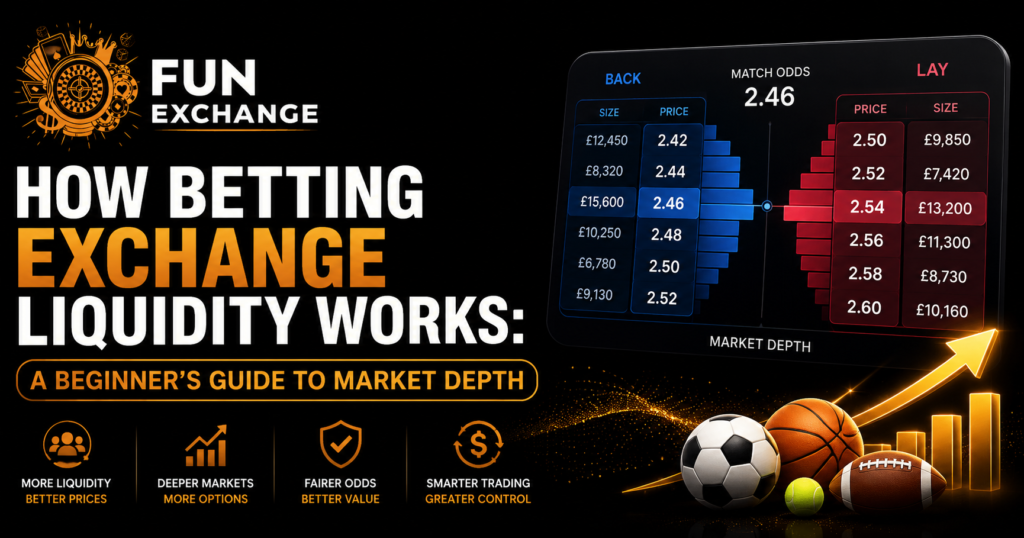
When people first explore a betting exchange, the odds usually get most of the attention. You see a back price, a lay price and perhaps several numbers sitting beside them. It can look straightforward until you notice that the amount available at each price is different.
That is where betting exchange liquidity becomes important.
Liquidity helps explain how much money is available in a market and how easily opposing positions can be matched. It can also help you understand why a price displayed on screen may not always be available for the entire amount you want to place.
For anyone learning how an exchange works, understanding liquidity and market depth is useful because it adds another layer of information beyond the headline odds.
What Is Betting Exchange Liquidity?
In simple terms, betting exchange liquidity refers to the amount of money available to be matched between participants in a market.
An exchange needs opposing positions to create a match. One participant may want to back an outcome, while another may want to lay that same outcome.
If enough money is available on both sides, positions can be matched more easily.
A market with substantial money available across several prices is generally considered more liquid than a market with very little money available.
Think of it like a marketplace.
A busy marketplace has many buyers and sellers. If you want to trade something, you are more likely to find someone willing to take the opposite side.
A betting exchange follows a similar principle.
What Does Market Depth Mean?
Market depth describes how much money is available across different prices in an exchange market.
Instead of looking at only one price, imagine seeing several levels:
| Price | Available Amount |
|---|---|
| 1.80 | ₹5,000 |
| 1.82 | ₹8,500 |
| 1.84 | ₹12,000 |
| 1.86 | ₹18,000 |
This gives you more information than simply seeing a single price of 1.80.
You can see how much money is available at different levels and get a better idea of how active the market is.
A deeper market may have more money distributed across multiple prices. A thinner market may have only small amounts available.
This distinction becomes particularly relevant when dealing with larger stakes or less popular sporting events.
Why Does Liquidity Matter?
Liquidity matters because an exchange is based on matching participants.
Suppose you see a back price that looks attractive and decide to place ₹10,000.
If only ₹2,000 is available at that price, the entire ₹10,000 cannot necessarily be matched at the displayed price.
The remaining amount may need to be matched at another available price, depending on the platform and market conditions.
This is why experienced exchange users tend to look beyond the first number they see.
They consider both:
- The price
- The amount available at that price
The combination gives a more complete picture of the market.
Back and Lay Prices: Where Liquidity Appears
Liquidity is closely connected with back and lay betting markets.
A back price represents support for an outcome, while a lay price represents opposition to it.
For example, imagine a cricket match where Team A is trading at:
Back: 1.90
Lay: 1.92
The small difference between the two prices can be viewed as part of the current market structure.
Now imagine the available amounts are:
Back 1.90 — ₹15,000 available
Lay 1.92 — ₹10,000 available
Those amounts tell you something that the odds alone cannot.
The market has money available at those particular levels, but the amounts are not unlimited.
This is one reason market depth is worth learning before using an exchange regularly.
What Is a Thin Market?
A thin market has relatively little money available to be matched.
This can happen with:
- Lower-profile sporting events
- Smaller competitions
- Less popular matches
- Certain player markets
- Specialist or niche markets
- Events with limited participation
For example, a major international cricket final may attract significant attention, while a lower-profile domestic fixture may have much less activity.
That does not automatically make one market “better” than another.
It simply means the amount of available money can be different.
In a thin market, users may need to pay closer attention to the available amount and price movement.
What Is a Deep Market?
A deep market has substantial money distributed across multiple prices.
Large sporting events often attract more participants because more people are watching them and looking to take positions.
Popular markets can therefore develop greater depth.
A deep market may offer:
- More available money
- More price levels
- Greater participation
- Easier matching
- More visible market activity
However, liquidity can change continuously. A market that is deep at one moment may become thinner later.
Liquidity Can Change During an Event
Liquidity is not fixed.
Before a match begins, participants may place positions based on expected line-ups, form, injuries, weather and other information.
Once the event starts, new information arrives constantly.
In cricket, a wicket can change the market.
In football, a goal can trigger a rapid reassessment.
In tennis, a break of serve can move prices sharply.
As prices change, money can be matched, removed or added at different levels.
This means the market you see before the event may look very different from the market ten minutes later.
Fun Exchange describes its live sports markets as having real-time odds across cricket, football and tennis.
How Liquidity Affects Price Movement
Imagine a market where there is only a small amount of money available around the current price.
If a relatively large order is matched, the available money at that level may disappear quickly.
The market can then move toward the next available price.
Now compare that with a deeper market where significantly more money is available across several nearby price levels.
The same transaction may have less impact on the visible market.
This is why market depth can help explain why some exchange prices move more dramatically than others.
It is not simply about whether an event is popular. The distribution of available money also matters.
Does Higher Liquidity Mean Better Odds?
Not necessarily.
This is an important distinction.
Liquidity and price are two different things.
Liquidity tells you about the amount of money available to be matched.
The price tells you the current market valuation of an outcome.
A highly liquid market can still have a price that you do not consider attractive.
Likewise, a thin market can display a price that looks appealing, but there may be very little money available at that level.
Therefore, liquidity should be viewed as additional market information rather than a signal that an outcome is likely to win.
Liquidity and the Difference Between Price and Availability
One of the easiest mistakes for a new exchange user is assuming that the displayed price applies to any amount.
It may not.
Consider a simplified example:
You see a back price of 2.00 with ₹1,000 available.
You want to place ₹5,000.
The displayed price only shows ₹1,000 available at that level. The rest may need to be matched at different prices if suitable liquidity exists.
This is why it is useful to check both the price and the available amount before confirming an order.
Why Major Cricket Markets Can Be More Active
Cricket has a particularly strong following in India, and major competitions can attract substantial market participation.
Fun Exchange lists markets covering competitions such as the IPL, international cricket, the Asia Cup, Champions Trophy, Test cricket, ODIs, T20s, BBL, CPL, PSL and other events.
The most popular matches can naturally attract more attention than obscure fixtures.
But popularity alone does not guarantee a particular level of liquidity.
Market activity can vary according to:
- Competition
- Match importance
- Time of day
- Stage of the tournament
- Pre-match versus live status
- Current match situation
- Number of active participants
So it is better to check the market itself rather than assume liquidity based solely on the event name.
Football Market Depth
Football provides another useful example.
A major Premier League or Champions League match can attract participants across several markets.
The match-winner market may have considerable activity, while a highly specific player or event market may have much less.
Fun Exchange’s football section includes markets covering match results, goals, player outcomes, corners and cards.
This means liquidity can vary significantly within the same match.
A popular main market may have substantial depth, while a specialist market could be comparatively thin.
Tennis and Rapid Market Changes
Tennis is particularly interesting because the match develops point by point.
A player wins a point.
Then another.
A break of serve can follow.
A set can change the overall match situation.
Fun Exchange describes its tennis markets as updating rapidly during live play, with markets covering matches, sets, games and player-related outcomes.
Because prices can react quickly, available liquidity can also change rapidly.
For beginners, this is another reason not to treat the number shown on screen as a permanent price.
Pre-Match Liquidity vs Live Liquidity
Liquidity can behave differently before and during an event.
Pre-Match
Before the event:
- Participants have more time to assess information.
- Team news can influence prices.
- New money may enter as the start approaches.
- Market activity can increase closer to kick-off or start time.
Live
During the event:
- New information arrives continuously.
- Prices can change quickly.
- Existing orders may be matched.
- Available amounts can move from one price level to another.
Neither situation is automatically preferable.
They simply require different levels of attention.
How Beginners Can Read Market Depth
You do not need advanced trading knowledge to start reading market depth.
Use a simple routine.
Step 1: Identify the Market
First, confirm what you are actually looking at.
Is it:
- Match winner?
- Total goals?
- Total runs?
- Player market?
- Set market?
- Another specialist market?
Step 2: Look at Both Sides
Do not focus exclusively on the back side.
Look at the available lay prices too.
Step 3: Check the Amount
Ask how much money is available at the price you are considering.
Step 4: Look at Nearby Prices
Check whether meaningful amounts are available at the next few price levels.
Step 5: Watch for Movement
If the market is live, prices can change quickly. Avoid assuming that what you saw a few seconds ago is still available.
Five Common Liquidity Mistakes
1. Looking Only at the Odds
The price is important, but the available amount matters too.
2. Assuming Every Market Has Equal Liquidity
A main match market and a niche player market can have very different levels of activity.
3. Ignoring Market Depth
Looking at one price gives you only part of the picture.
4. Treating Live Markets as Static
Live prices and available amounts can change rapidly.
5. Assuming Liquidity Predicts the Winner
Liquidity describes market participation and available money. It does not guarantee an outcome.
Is Liquidity Important for Every User?
Yes, but its importance can vary.
For someone exploring small recreational positions, basic awareness may be enough.
For someone who regularly studies exchange markets, larger positions or live markets, understanding depth becomes much more important.
The key idea is simple:
Price tells you what is currently being offered. Liquidity tells you how much is available around that price.
Understanding both gives you a clearer view of an exchange market.
Frequently Asked Questions
What is betting exchange liquidity?
Betting exchange liquidity is the amount of money available to be matched between opposing participants in a market.
What does market depth mean in betting?
Market depth shows the amount of available money across different prices rather than focusing on one price level.
Why can my entire amount not match at one price?
There may not be enough money available at that specific price. Any unmatched portion may require another available price, depending on the market.
Are popular sports always more liquid?
Not necessarily. Major events often attract more activity, but liquidity can vary by market, timing and participant interest.
Does high liquidity mean an outcome is more likely to win?
No. Liquidity describes market activity and available money. It should not be interpreted as a guarantee of the result.
Does liquidity change during live betting?
Yes. Prices and available amounts can change as new information enters the market and existing positions are matched.
Final Takeaway
Learning to read liquidity is one of the easiest ways to move beyond simply looking at betting odds.
A sports exchange is a marketplace, and market depth shows you how much activity exists around different prices. A deep market can have substantial money spread across multiple levels, while a thin market may have relatively little available.
The most useful habit is to look at price, available amount and nearby price levels together.
Whether you are exploring cricket, football or tennis markets on Fun Exchange, understanding liquidity can help you interpret the market screen more clearly and avoid assuming that every displayed price is available in unlimited quantity. Fun Exchange currently promotes exchange-style markets across 30+ sports, including cricket, football and tennis.
Most importantly, liquidity is information—not a prediction. It does not tell you which team or player will win.
Sports betting involves financial risk. Treat it as entertainment, set a budget, avoid chasing losses and only use money you can afford to lose.